The word topology means ‘arrangement’, so when we talk about the topology of a network, we mean how the different parts are arranged and connected together.
There are three common network topologies...
There are three common network topologies...
Bus Network
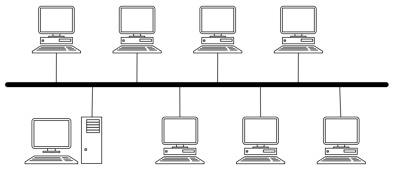
In this type of network, a long, central cable, the ‘bus’ is used to connect all of the computers together. Each computer has a short cable linking it to the ‘bus’.
A bus network…
- Is cheap to install (just one long cable)
- Can be quite slow since all computers share the same cable when communicating
- Will stop working if there is a break in the central bus cable.
Ring Network
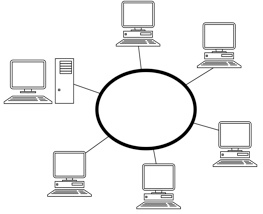
In this type of network each computer is connected to a loop of cable, the ‘ring’. (If you took a bus network and connected the ends of the bus cable together, you would have a ring network.)
A ring network…
- Can cope with a break in the ring cable since all computers are still joined together (it is now a bus network)
Star Network
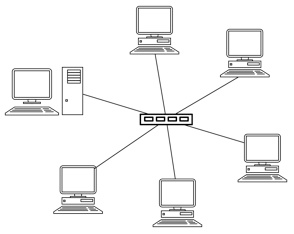
In this type of network every computer is connected to a central device. The device passes messages between computers.
At the centre of a star network you might use a hub (cheap, but slower) or a switch (more expensive, but faster).
A star network…
At the centre of a star network you might use a hub (cheap, but slower) or a switch (more expensive, but faster).
A star network…
- Is quite expensive to install (you have to buy lots of cable and the central device)
- Is very fast since each computer has its own cable which it doesn’t need to share
- Can cope with a broken cable (only one computer will be affected)
- Will stop working if the central device breaks
- Is the most common network topology
Hybrid Network
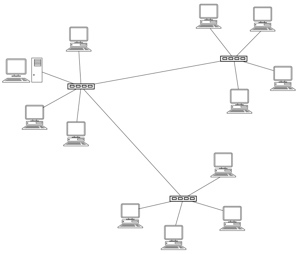
A hybrid network is simply one that combines two or more of the above basic topologies.
E.g. A network that has several star networks linked together is a hybrid network
E.g. A network that has several star networks linked together is a hybrid network